
 GB · EN


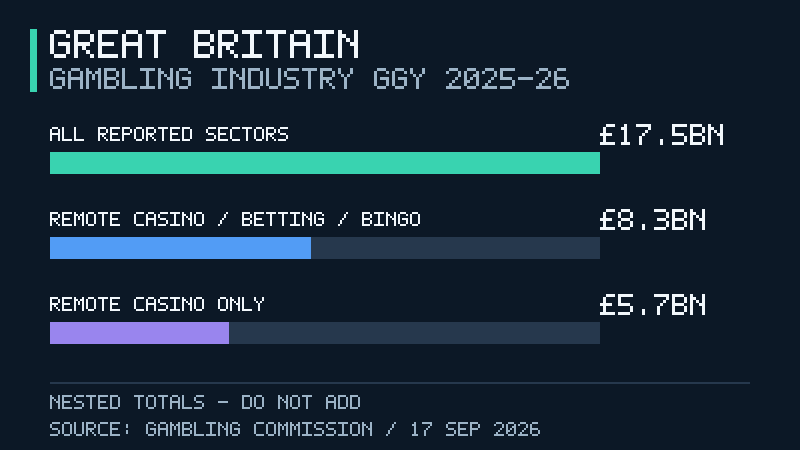
On 17 September 2026, the Gambling Commission published its annual industry figures for the financial year ending March 2026. Licensed, customer-facing gambling activity in Great Britain produced gross gambling yield (GGY) of £17.5 billion, 4.4% more than the preceding financial year. These are operator-reported figures for a particular market and period, not a new estimate of how many people gamble.
The figures at a glance
| Measure | April 2025–March 2026 | Year-on-year change |
|---|---|---|
| All reported sectors, including lotteries | £17.5bn GGY | +4.4% |
| Excluding reported lotteries | £13.2bn GGY | +4.7% |
| Remote casino, betting and bingo combined | £8.3bn GGY | +6.9% |
| Land-based arcades, betting, bingo and casino | £4.9bn GGY | +1.1% |
| Licensed gambling premises | 8,081 | −2.0% |
| Betting shops | 5,617 | −3.6% |
Source: the Gambling Commission's annual release. These rows overlap: remote activity is included in the total, and betting shops are a subset of premises. The amounts are rounded and must not be added together as independent categories.
The regulator's accompanying blog identifies remote casino specifically as £5.7 billion in GGY, an increase of £736 million. This is a subset of the £8.3 billion remote sector, not an additional sum.
What is gross gambling yield?
GGY is broadly the amount retained from gambling activity after winnings are deducted, before business expenses and taxes. It is not company profit, total deposits, or a count of individual customers' losses. A rising aggregate does not by itself identify how much any one person spent, whether participation increased, or which factors caused the change.
The geographical scope is Great Britain. Readers should not apply the figures to Northern Ireland, Sweden or the global market. The reporting period ends in March 2026, not November 2026.
November update: operator figures and survey estimates answer different questions
On 19 November 2026 the Office for Statistics Regulation (OSR) issued a follow-up review of the Gambling Survey for Great Britain (GSGB). The review found six of nine earlier recommendations met, while three were partially met. It also introduced a further recommendation on communicating research findings. OSR expects another public progress update by the end of February 2027.
This review concerns the survey, not an adjustment to the £17.5 billion industry figure. Regulatory returns describe activity reported by licensed businesses; the survey estimates experiences reported by people. Neither dataset alone establishes the prevalence of gambling harm or explains the causes of market growth. When comparing them, use the relevant fieldwork dates, reporting periods, population and definitions.
What to watch in subsequent releases
The Commission has aligned the release of quarterly industry data with annual statistics and survey results. That makes comparisons easier to plan, but figures can still be revised as operators submit corrected data. A future quarterly result should not be compared directly with a full-year figure.
For further regulatory context, see our earlier coverage of the Commission's invitation for proposals on regulatory burdens. That initiative is distinct from the published industry statistics.
Sources and methodology
- Gambling Commission: annual statistics announcement, 17 September 2026
- Gambling Commission: annual report, April 2025–March 2026
- Gambling Commission: Industry Statistics 2026 explainer
- Office for Statistics Regulation: follow-up letter, 19 November 2026
Figures have been checked against the regulator's published release and explainer. This article does not claim independent analysis of individual operator returns or survey responses.
We check licensing, terms, payments, and available player-protection tools. Commercial relationships do not change our evidence standards.


Comments
Keep comments constructive. Every comment is reviewed before publication.